


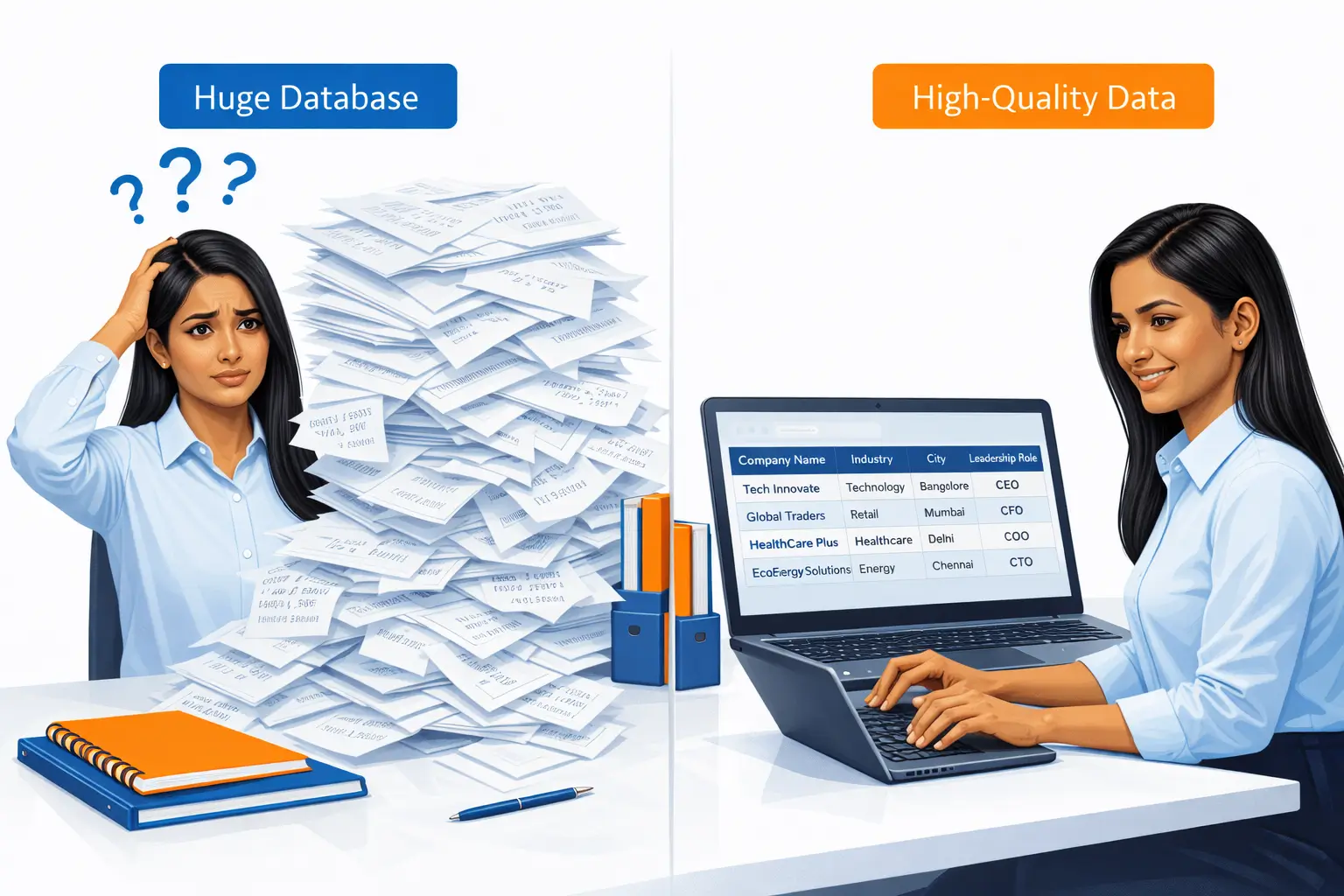
Why Data Quality Matters More Than Database Size
Introduction
Many businesses believe that a larger database automatically leads to better results. They assume that more contacts mean more opportunities.
However, modern businesses are learning an important lesson. The quality of data matters far more than the size of a database.
A large list of contacts may appear valuable, but if the information is incomplete, outdated, or poorly organized, it becomes difficult to use.
Companies today focus on accurate and structured business data rather than simply collecting large numbers of contacts.
Platforms such as GetDatabase
focus on organizing company information in a structured way so businesses can analyze markets and identify relevant organizations.
Understanding the importance of data quality helps companies make better research and planning decisions.
Data Quality Definition
Data quality refers to the accuracy, completeness, reliability, and organization of information within a database.
High-quality business data usually includes:
-
accurate company names
-
correct industry classification
-
updated company locations
-
clearly defined leadership roles
-
structured company profiles
When the information is organized and reliable, businesses can analyze markets and identify opportunities more effectively.
Companies often review structured Business Databases
to access organized company information for research purposes.
Why Database Size Alone Is Not Enough
Large databases often contain thousands of contacts. However, size does not guarantee usefulness.
A database may contain many entries but still lack important information.
Common problems in oversized databases include:
-
outdated company information
-
missing industry classification
-
incorrect professional roles
-
duplicated contacts
Without proper organization, large datasets become difficult to analyze.
Businesses increasingly prioritize data accuracy and structure instead of database volume.
How High-Quality Data Improves Business Research
High-quality data helps businesses understand markets more clearly. Below are the main ways accurate data improves business research.
1. Accurate Industry Identification
Businesses must understand which industries companies belong to before conducting research or planning outreach.
High-quality data categorizes companies by industry.
For example, businesses studying industrial sectors may explore Manufacturing Databases
to analyze companies operating within manufacturing industries.
Industry classification helps businesses focus on relevant markets.
2. Clear Professional Role Information
Many business decisions are made by senior professionals such as founders, directors, or executives.
High-quality datasets clearly identify professional roles.
Companies analyzing leadership structures may review CXO Databases
to understand executive roles within organizations.
Accurate role information helps businesses understand company decision structures.
3. Reliable Geographic Information
Location data is essential for businesses studying regional markets.
High-quality datasets clearly organize companies by geographic location.
Companies exploring regional ecosystems may analyze Mumbai Business Databases
to understand organizations operating in specific cities.
Accurate geographic information helps companies plan location-focused strategies.
4. Better Market Understanding
High-quality data allows businesses to study market ecosystems more effectively.
Companies can analyze:
-
industry clusters
-
regional business hubs
-
leadership networks
This level of insight is difficult to achieve with poorly structured data.
Structured datasets help businesses see patterns across industries and regions.
Platforms like GetDatabase
organize company information so businesses can analyze markets more efficiently.
5. Faster and More Reliable Research
When data is accurate and well structured, businesses spend less time verifying information.
Research becomes faster because:
-
company details are already organized
-
industry categories are clearly defined
-
leadership roles are identified
This allows teams to focus on analysis rather than data cleaning.
Common Problems With Poor Data Quality
Low-quality data creates several challenges for businesses.
Outdated Information
Companies change locations, industries, or leadership over time. Old data quickly becomes inaccurate.
Missing Context
Contact lists may contain phone numbers or emails but lack company background information.
Difficult Data Analysis
Unorganized data makes it difficult for businesses to analyze industries or markets.
Inefficient Research
Teams spend excessive time correcting or verifying information.
These problems show why data quality is more valuable than database size.
Why Businesses Focus on Data Quality Today
Modern business strategies rely on precision and accuracy.
Organizations prefer smaller but reliable datasets over large but inaccurate lists.
High-quality data offers several advantages:
Clear Market Insights
Businesses can analyze industries more accurately.
Better Audience Identification
Companies can identify organizations that match their objectives.
Faster Decision Making
Leadership teams can make informed decisions using reliable information.
Improved Research Efficiency
Teams spend less time organizing data and more time understanding markets.
Structured platforms such as GetDatabase
help businesses access organized company information that supports research and planning.
Key Takeaways
-
Data quality refers to the accuracy and reliability of information within a database.
-
Large databases are not useful if the data is outdated or poorly organized.
-
Accurate industry classification helps businesses understand markets.
-
Professional role data helps identify leadership structures.
-
Reliable geographic data supports regional research.
-
High-quality data improves research efficiency and strategic planning.
Frequently Asked Questions (FAQs)
What is data quality in a business database?
Data quality refers to the accuracy, completeness, and reliability of company information within a database.
Why is data quality more important than database size?
High-quality data provides accurate information that businesses can analyze effectively, while large databases may contain outdated or incomplete data.
What makes business data high quality?
High-quality business data includes accurate company names, industry classifications, locations, and clearly defined leadership roles.
How does data quality affect business research?
Reliable data allows businesses to analyze industries, identify organizations, and understand market ecosystems more effectively.
Do companies prefer smaller but accurate datasets?
Yes. Many businesses prefer smaller datasets with accurate information rather than large lists with unreliable data.