


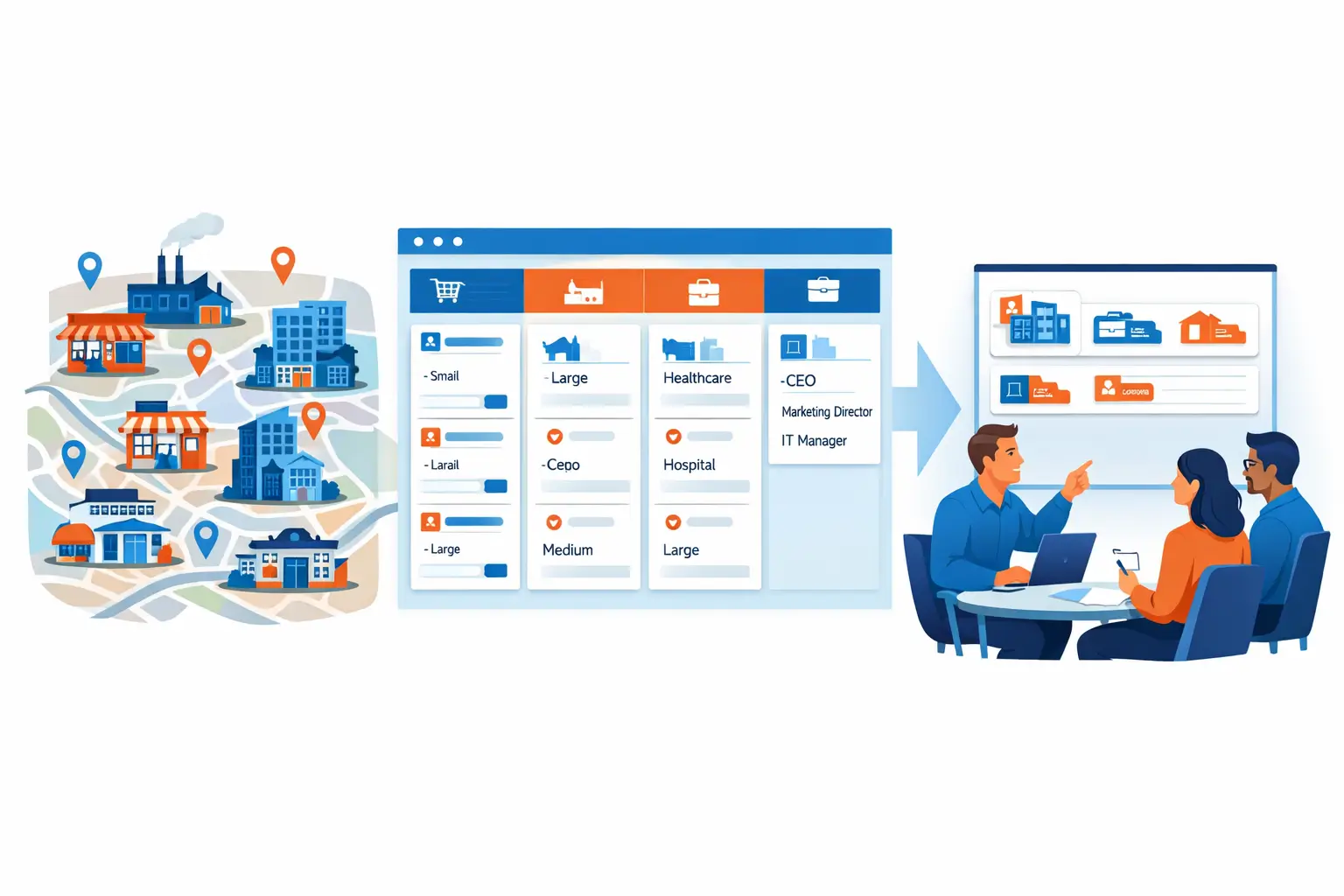
A. Introduction: Why Client Targeting Is a Major Challenge for IT Companies
Business databases for IT companies
IT companies face a common issue.
They have strong technical skills.
But they struggle to find the right clients.
Many IT firms target too broadly.
They approach startups and enterprises together.
They mix industries with very different needs.
This leads to wasted effort.
A healthcare company buys technology differently than a retailer.
A manufacturing firm has different priorities than a startup.
Client targeting fails when these differences are ignored.
Business databases help IT companies solve this problem.
They bring structure to targeting.
They replace guesswork with clarity.
In a competitive IT market, this clarity matters.
B. Clear Definition: What Are Business Databases for IT Client Targeting?
Business databases for IT companies
A business database is a structured collection of company-level information organized by industry, location, size, and business type.
For IT companies, these databases help identify organizations that are more likely to need specific technology solutions. They support research and targeting preparation.
Business databases do not execute outreach.
They help IT companies decide who to focus on.
This distinction is important.
C. Why IT Companies Depend on Business Databases
The IT market is complex.
Client needs vary widely.
Some companies need basic systems.
Others need advanced infrastructure.
Business databases exist to help IT companies:
- Understand market structure
- Identify relevant industries
- Narrow client focus
- Reduce wasted targeting
Without structured data, IT firms rely on assumptions.
D. Types of Business Databases IT Companies Use
1. Industry-Based Business Databases
Industry context shapes technology needs.
IT solutions are not one-size-fits-all.
IT companies analyze relevance using industry-sector-specific business databases
This helps focus on industries with real demand.
2. Company and Corporate Databases
Company size affects technology decisions.
Enterprises and MSMEs buy differently.
IT firms study company and corporate business databases
This improves alignment with company maturity.
3. Location-Based Business Databases
Business databases for IT companies
Geography influences adoption.
Budgets, regulations, and infrastructure vary.
IT companies plan regionally using city and pincode-wise business databases
This improves regional targeting accuracy.
4. Professional and Decision-Maker Databases
Technology decisions are not made by everyone.
Specific roles influence approval.
IT companies identify authority using decision-maker and professional databases
This clarifies who evaluates technology investments.
E. Real Business Use Cases (Simple and Practical)
Sales Planning for IT Firms
Sales teams perform better when focus is narrow.
Studying segmented company databases by industry
helps reduce irrelevant targeting.
Market Research for IT Solutions
IT companies study demand patterns using IT industry business datasets
This helps understand competitive environments.
Recruitment and Capability Planning
IT firms plan teams using role-based professional databases
This supports internal growth decisions.
Partnership Identification
IT companies explore ecosystems using professional firms and service databases
This supports strategic collaboration planning.
F. Common Client Targeting Mistakes IT Companies Make
- Targeting all industries equally
- Ignoring company size differences
- Assuming every firm needs the same solution
- Overlooking decision-maker roles
- Using unstructured research
These mistakes reduce targeting success.
G. How Structured Databases Improve IT Client Targeting
Structured databases bring focus.
IT companies can:
- Prioritize high-fit clients
- Avoid irrelevant segments
- Plan targeting logically
For example, analyzing mid-level and operational role databases
helps identify implementation influencers.
Studying industry-aligned MSME databases
clarifies growth-stage opportunities.
Better structure leads to better targeting.
H. Summary (Fast Read)
- IT client targeting requires precision
- Business databases improve focus
- Industry context matters
- Location influences adoption
- Roles define authority
- Structured data improves outcomes
I. FAQs (Google + AI Optimized)
1. Why do IT companies use business databases for client targeting?
Business databases help IT companies identify industries, regions, and company profiles that align with their offerings. This improves targeting accuracy.
2. Are business databases useful for small IT companies?
Yes. Small IT firms benefit by focusing effort on high-potential client segments.
3. Do business databases replace sales strategy?
No. They support research and targeting preparation, not execution.
4. How often should IT companies review database insights?
Before major targeting, expansion, or market entry decisions.
5. Can IT companies use databases to enter new industries?
Yes. Industry-level data helps evaluate new markets before targeting.