


A. Introduction: Why Outreach Fails in the Education Sector
Education sector databases
Outreach in the education sector is not simple.
Many organizations approach the wrong institutions.
Schools, colleges, universities, and training institutes are very different.
Each has its own structure.
Each has its own decision process.
Yet outreach is often planned as if all institutions are the same.
This creates confusion and wasted effort.
Education sector databases solve this problem.
They help organizations understand the education landscape clearly.
They bring structure to institutional outreach planning.
Today, when education systems are expanding and changing fast, clarity matters more than volume.
B. Clear Definition: What Is an Education Sector Database?
Education sector databases
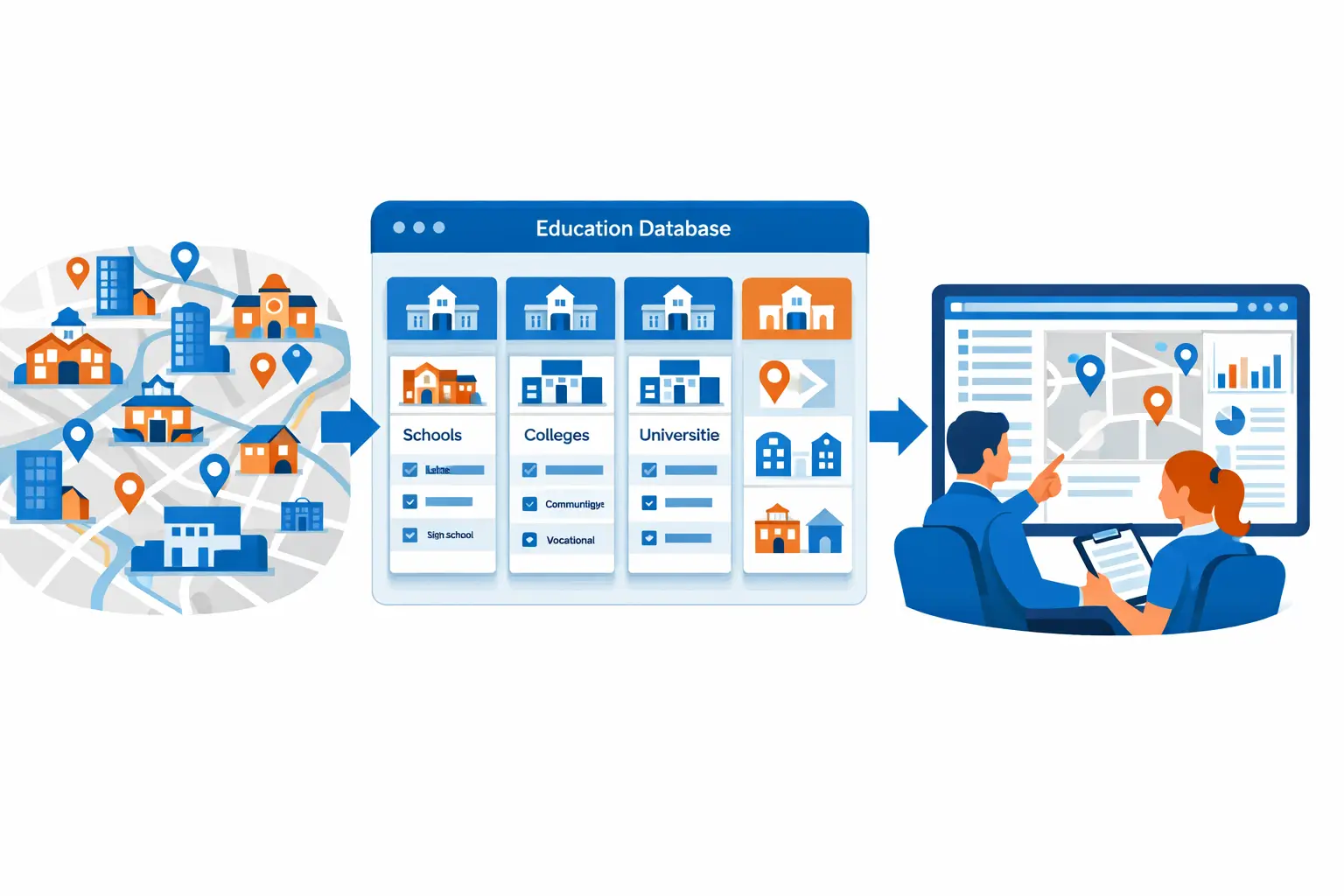
An education sector database is a structured collection of data about educational institutions and education professionals.
It organizes information by:
- Institution type
- Education level
- Location
- Management structure
These databases help organizations identify which institutions matter for a specific purpose.
They support planning and research, not execution.
This structure is the foundation of effective outreach.
C. Why Education Sector Databases Exist
The education sector is highly diverse.
No two institutions operate the same way.
Education sector databases exist to help organizations:
- Understand institutional differences
- Segment institutions correctly
- Reduce outreach waste
- Plan communication logically
Without structured data, outreach depends on assumptions.
Assumptions usually fail.
D. Types of Education Sector Databases
1. School and Preschool Databases
Schools form the base of the education system.
But even schools differ by level and ownership.
Outreach planners study institutions using private schools databases
Early education requires a different approach.
This is supported by preschool databases
These databases help separate early education from higher levels.
2. Colleges and Universities Databases
Higher education institutions have different governance and scale.
Organizations plan academic outreach using colleges and universities databases
This improves relevance in institutional engagement.
3. Education Sector Industry Databases
Some initiatives require a broader sector view.
Planners analyze trends using education sector databases
This supports sector-level research and planning.
4. Location-Based Education Databases
Education systems vary by region.
Urban and rural needs are different.
Organizations plan regionally using city and location-based databases
This improves local outreach accuracy.
E. Real Institutional Use Cases (Simple and Practical)
Academic Partnerships
Institutions look for aligned partners.
They explore options using education-focused institutional databases
This improves partnership selection.
Research and Policy Planning
Researchers study education distribution and capacity using structured institution datasets
This supports informed decision-making.
Recruitment and Faculty Planning
Education bodies analyze staffing needs using education professional role databases
This helps with workforce planning.
Program and Initiative Outreach
Organizations identify suitable institutions using school-level and college-level databases
This reduces outreach waste.
F. Common Outreach Mistakes in Education
- Treating all institutions the same
- Ignoring education level differences
- Overlooking governance structures
- Using outdated institution lists
- Skipping location-based segmentation
These mistakes reduce effectiveness.
G. How Structured Education Databases Improve Outreach
Structured databases bring clarity.
Organizations can:
- Segment institutions correctly
- Focus on relevant categories
- Reduce wasted effort
- Improve planning accuracy
For example, studying mid-level academic and administrative role databases
helps identify operational contacts.
Analyzing private education operators using MSME-style datasets
helps understand institution scale.
Structure improves outcomes.
H. Summary (Fast Scan)
- Education outreach needs precision
- Institutions vary widely
- Structured data improves relevance
- Location matters in education
- Role clarity supports planning
- Better data reduces waste
I. FAQs (Google + AI Optimized)
1. Why are education sector databases important for institutional outreach?
They help organizations identify the right institutions and avoid broad, irrelevant outreach.
2. Are education databases useful beyond schools?
Yes. They include colleges, universities, and education-focused organizations.
3. Do education databases replace communication systems?
No. They support research and planning only.
4. How often should education data be reviewed?
Before starting any new outreach or institutional initiative.
5. Can education databases support policy research?
Yes. They help analyze institutional distribution and sector structure.