


Introduction
Many businesses still use bulk contact lists.
They believe more contacts mean more results. That logic fails today.
Modern outreach depends on relevance, not volume. When lists are unsegmented, messages reach the wrong people. As a result, response drops and effort increases.
This blog explains why unsegmented lists fail and what companies should do instead.
What Is an Unsegmented Contact List?
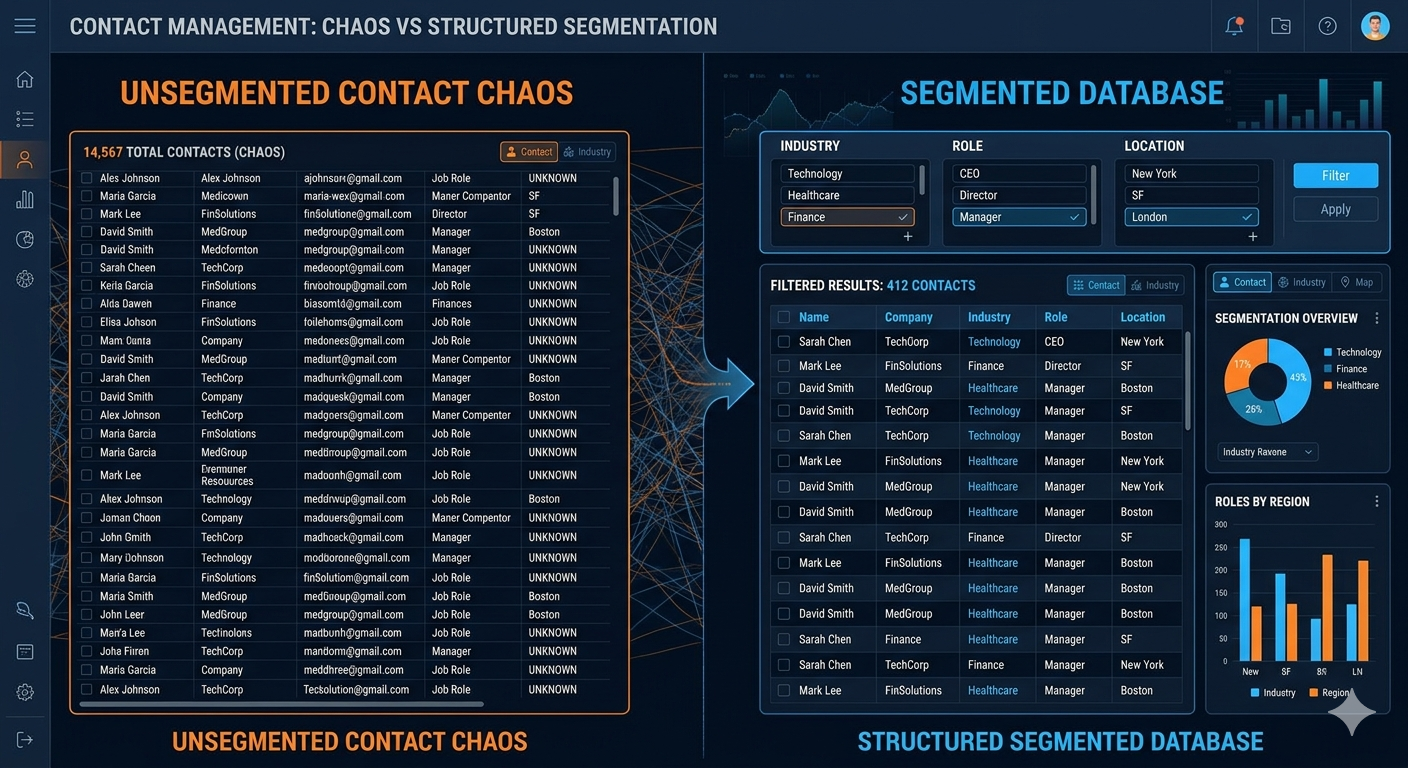
An unsegmented list is a collection of contacts without filters.
It mixes different:
- Industries
- Job roles
- Locations
- Business sizes
This creates one major issue: no targeting.
To understand how structured data solves this, explore Business Database Solutions
Why Unsegmented Contact Lists Fail
1. No Audience Relevance
Different people have different needs.
A founder, a manager, and a retailer cannot receive the same message. However, unsegmented lists treat them as identical.
Because of this, messages feel irrelevant. People ignore them.
2. Low Response Rates
When targeting is weak, responses drop.
Even if the list is large, engagement stays low. Therefore, outreach becomes inefficient.
3. Wasted Time and Effort
Teams spend time sending messages to the wrong audience.
Instead of focusing on quality, they chase quantity. This reduces productivity.
4. Poor Brand Perception
Irrelevant communication damages trust.
When businesses send generic messages, they appear unprofessional. Over time, this affects credibility.
5. No Data Insights
Unsegmented data cannot be analyzed properly.
You cannot answer:
- Which industry responds better?
- Which location performs well?
- Which role converts?
Without segmentation, there is no clarity.
Modern Outreach Requires Segmentation
Today, outreach works differently.
Businesses must:
- Target specific industries
- Focus on decision-makers
- Adapt messaging by audience
For example, using Professional Database for Decision Makers helps target the right roles.
Similarly, Industry-Specific Business Data allows niche communication.
Types of Segmentation That Matter
1. Industry Segmentation
Different industries need different solutions.
2. Role-Based Segmentation
A CEO and a manager think differently.
3. Location Segmentation
Regional markets behave differently.
You can explore this through City-Wise Business Database
4. Business Size Segmentation
Startups and enterprises have different priorities.
Real-World Impact of Poor Segmentation
Example 1: B2B Outreach
A company sends the same message to all contacts.
Result:
- Low replies
- No conversions
- High effort
Example 2: Real Estate Targeting
A firm targets everyone instead of investors.
Result:
- Irrelevant leads
- Wasted budget
Example 3: Financial Services
A company sends generic offers to all contacts.
Result:
- No engagement
- Poor trust
Common Mistakes Businesses Make
1. Assuming Bigger Lists Work Better
Size does not guarantee results.
2. Ignoring Data Structure
Raw data is not useful without organization.
3. No Filtering Before Use
Many teams skip segmentation entirely.
4. Treating Data as Ready Leads
Data is a starting point, not the final outcome.
To avoid these mistakes, read Common Data Mistakes Businesses Make
Structured Data vs Unsegmented Lists
| Factor | Segmented Data | Unsegmented List |
|---|---|---|
| Targeting | High | Low |
| Relevance | Strong | Weak |
| Efficiency | High | Poor |
| Insights | Clear | Confusing |
This difference directly affects results.
How to Fix Unsegmented Data
Follow a simple process:
- Define your target audience
- Choose the right dataset
- Apply filters (industry, role, location)
- Customize communication
- Track performance
To start, you can Request a Business Database
Why Data Quality and Trust Matter
Segmentation only works when data is reliable.
Key factors:
- Clean structure
- Updated records
- Logical grouping
Poor-quality data leads to poor targeting.
Summary
- Unsegmented lists fail due to lack of relevance
- Modern outreach depends on targeted data
- Segmentation improves efficiency and response
- Data is a foundation, not a guarantee
- Quality and structure define success
FAQs
What is an unsegmented contact list?
It is a list without filters like industry, role, or location.
Why do unsegmented lists fail?
Because they lack relevance and targeting.
What is segmentation in business data?
It means dividing data into meaningful groups.
Does segmentation improve results?
Yes. It increases relevance and response rates.
Is data enough for outreach success?
No. Strategy and execution are also required.